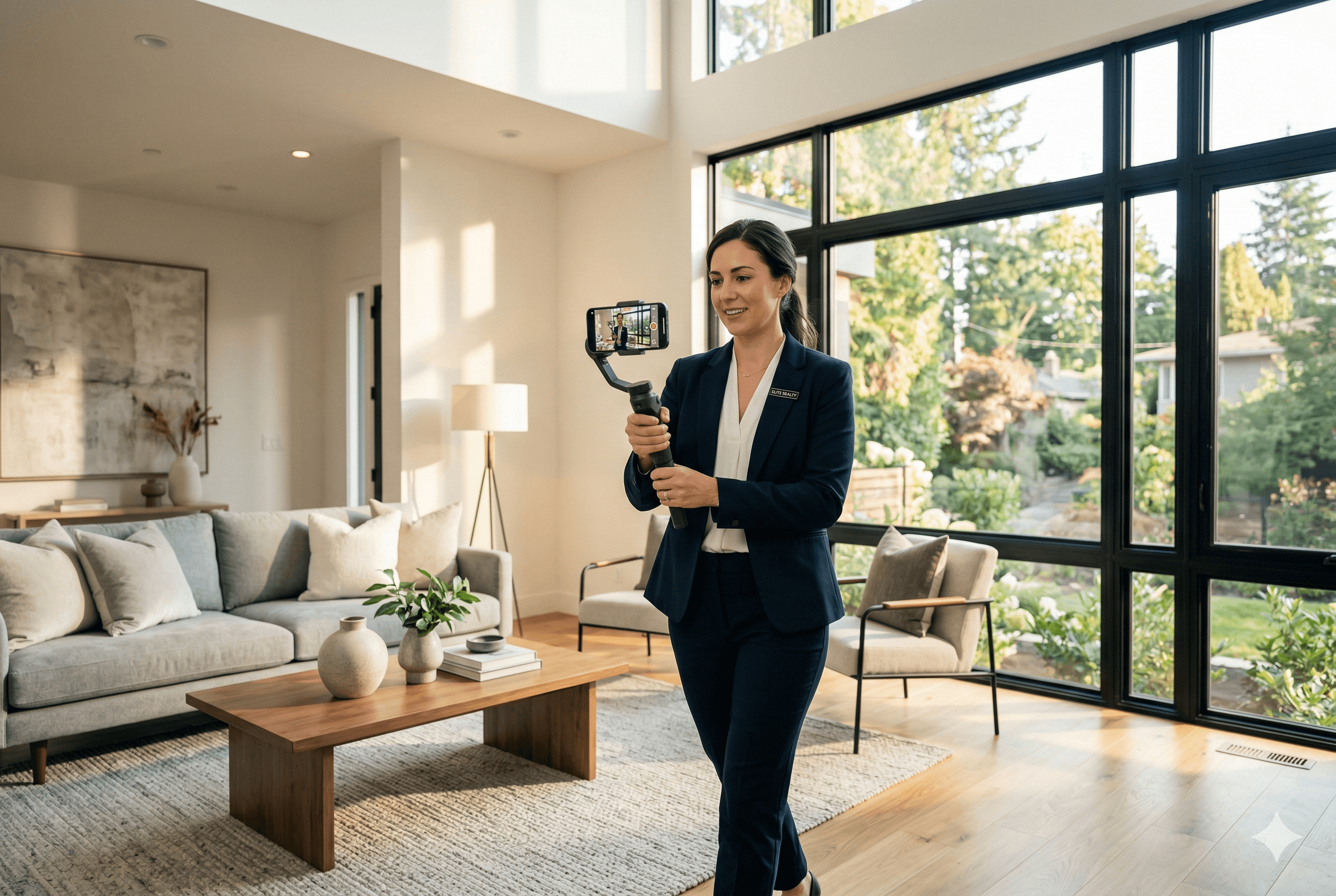
Real Estate Video Marketing: The Complete Guide for Agents
Everything real estate agents need to know about video marketing, from listing videos and neighborhood tours to AI tools, SEO, and distribution strategy. Data-driven, practical, and built for agents who want results without wasting time.
Hailey JeonMarketer, vProp10 min read
TL;DR
Real estate video marketing has moved well past being a nice-to-have. According to the National Association of Realtors, 73% of homeowners say they're more likely to list with an agent who uses video, yet most agents still treat video as something reserved for special occasions.
This guide covers the video formats that actually work for agents, from listing walkthroughs to neighborhood tours, and how to produce them without burning hours on every listing, including AI tools that turn photos you already have into a finished video.
Real estate video marketing is no longer a nice-to-have. It is the single most effective way for agents to generate qualified leads, sell listings faster, and build a brand that sellers actually want to hire.
Yet most agents still treat video as something reserved for luxury properties or special occasions. The data tells a different story. According to the National Association of Realtors, 73% of homeowners say they are more likely to list with an agent who uses video. Separately, video-marketed listings are widely reported across the industry to generate dramatically more inquiries and sell meaningfully faster than photo-only listings, though the exact multiples vary a lot depending on which study you read.
This guide covers everything you need to know about real estate video marketing in 2026: the types of videos that actually work, how to create them without burning hours, where to distribute them for maximum reach, and how to measure whether your video strategy is actually driving closings.
Why Video Is the Most Effective Real Estate Marketing Channel
The shift toward video in real estate is not a trend. It is a fundamental change in how buyers search for homes and how sellers evaluate agents.
Consider the buyer journey. Over 97% of homebuyers start their search online, according to NAR research. They scroll through dozens of listings on Zillow, Realtor.com, and Redfin before contacting a single agent. In that environment, the listings that stop the scroll win. And nothing stops a scroll like video.
Photos show rooms. Video shows how those rooms connect. A buyer watching a 60-second property tour understands the layout, the flow, the natural light, and the neighborhood feel in a way that 25 static images cannot communicate. That understanding translates directly into higher-quality inquiries, from buyers who have already pre-qualified themselves by watching the full video.
Hailey Jeon
Marketer, vProp
Hailey Jeon is a marketer at vProp, writing about real estate marketing, listing videos, and the tools agents use to win and market listings. Hailey's guides focus on practical steps agents can use on their very next listing.
On the seller side, video has become a differentiator in listing presentations. When two agents compete for a listing, the one who can show a portfolio of professional listing videos has a tangible advantage. Sellers want to know their home will be marketed aggressively, and video is the most visible proof of that commitment.
The 6 Types of Real Estate Videos Every Agent Should Know
Not all real estate videos serve the same purpose. The most effective video marketing strategies use multiple formats, each targeting a different stage of the buyer or seller journey.
1. Listing Tour Videos
This is the foundation of real estate video marketing. A listing tour walks the viewer through the property, highlighting key features and giving a sense of the home's layout and flow. The best listing tours run between 60 and 90 seconds, long enough to communicate the essentials, short enough to hold attention.
Listing tours work because they pre-qualify buyers. Someone who watches a full property tour and then requests a showing is far more serious than someone who clicked on a photo and sent a generic inquiry. Agents who use listing videos consistently report fewer wasted showings and faster time to offer.
2. Neighborhood Spotlight Videos
Buyers choose neighborhoods before they choose homes. A neighborhood spotlight video shows what daily life looks like in the area: the coffee shops, parks, walkability, commute routes, and community feel that buyers care about but listing descriptions rarely capture.
These videos are particularly powerful for attracting relocation buyers who cannot visit the area in person. They also have a longer shelf life than listing tours because the neighborhood does not change when a property sells.
3. Agent Introduction Videos
Before a buyer or seller trusts you with the biggest financial decision of their life, they want to know who you are. An agent introduction video is a 60-to-90-second piece where you share your background, your approach, and why you do what you do.
This is not a commercial. The best agent videos feel like a conversation, natural, confident, and focused on the client rather than the agent's accolades. These videos live on your website, your social profiles, and your email signature, working 24/7 to build trust before the first phone call.
4. Market Update Videos
Monthly or bi-weekly market update videos position you as the local expert. Cover median home prices, days on market, inventory levels, and what the numbers mean for buyers and sellers in your area.
Market updates build authority over time. They give you a reason to post consistently on social media, and they create content that other local businesses and news outlets may share, extending your reach beyond your existing audience.
The most effective real estate short-form content falls into a few categories: quick listing highlights with a hook ("This kitchen was NOT what I expected"), behind-the-scenes moments from showings or closings, educational tips for buyers and sellers, and community content that showcases your local expertise.
6. Drone and Aerial Videos
Drone footage adds a cinematic quality that elevates any listing presentation. It is especially valuable for properties with large lots, waterfront locations, mountain views, or proximity to notable landmarks. Aerial video communicates scale and context in a way that ground-level footage cannot.
Drone videos work best when combined with interior footage rather than used alone. The aerial shots establish the setting, and the interior walkthrough closes the experience.
How Real Estate Video Marketing Drives Measurable Results
The case for video is not just theoretical. The data is specific and consistent across multiple studies.
Video-marketed listings are widely reported across the industry to draw substantially more inquiries and sell faster than photo-only listings, and agents who lean into video consistently describe faster business growth too. Exact multiples vary by source, so treat any single number you see quoted, including elsewhere in this article, as a directional signal rather than a precise fact.
Beyond these headline numbers, video impacts every stage of the real estate transaction. On the listing acquisition side, agents with video portfolios win more listing presentations because sellers see tangible evidence of marketing investment. On the buyer side, video pre-qualifies leads by giving buyers enough information to self-select before requesting a showing.
Video also compounds over time. A listing tour serves one property, but a neighborhood spotlight, a market update, or an educational reel continues generating views, engagement, and leads long after it is published. This is the difference between video as a one-time expense and video as a marketing asset. See how agents are already using this approach to sell homes faster with video marketing, and learn how to optimize your videos for search engine rankings.
Creating Real Estate Videos Without Wasting Hours
The number one reason agents avoid video is time. Between client meetings, showings, negotiations, and paperwork, there is no room to add video production to the schedule.
This is where most real estate video marketing advice falls short. It tells agents to invest in equipment, learn editing software, and dedicate hours to production, which is exactly why adoption remains low despite overwhelming evidence that video works.
The practical solution is to build a repeatable system that minimizes production time while maintaining quality.
The Repeatable Video Framework
The agents who succeed with video are not the ones creating cinematic masterpieces. They are the ones who create a consistent format and apply it to every listing.
Start with a template. Choose one video style, a 60-second property walkthrough, for example, and use the same structure every time. Same intro, same music style, same pacing, same call to action. This eliminates the creative decision-making that slows most agents down.
Batch your production. If you have three new listings this week, shoot all three videos in one afternoon rather than spreading them across three separate sessions. Batching reduces setup time and keeps you in a production mindset.
Use the photos you already have. You are already investing in professional listing photography for every property. Modern AI tools can transform those photos into polished video content automatically. No videographer, no editing, no extra shoot required.
AI-Powered Video Creation for Real Estate
The emergence of AI video tools has fundamentally changed the economics of real estate video marketing. What used to require a $500-to-$2,000 investment per listing can now be accomplished in minutes from existing listing photos.
AI video platforms analyze your property photos, identify key features, select optimal sequencing, add professional transitions and music, and generate a ready-to-distribute listing video. The quality rivals traditionally produced content at a fraction of the time and cost.
This is not about replacing human creativity. It is about making video marketing accessible for every listing, not just the high-end ones. When video becomes as routine as uploading listing photos, the cumulative impact on lead generation and brand building is significant.
vProp uses this approach, transforming your existing listing photos into professional property videos automatically. No scheduling, no editing, no additional time investment. Every listing gets a video, and your marketing stays consistent.
Where to Distribute Your Real Estate Videos
Creating a great video is only half the equation. Distribution determines whether that video actually reaches buyers and sellers.
MLS and Listing Portals
Your listing video should be attached to every MLS entry. Zillow, Realtor.com, and Redfin all support video, and listings with video receive preferential treatment in their algorithms. More engagement signals (views, saves, shares) translate to higher visibility in search results.
Frequently Asked Questions
Does real estate video marketing actually work?
Yes. According to the National Association of Realtors, 73% of homeowners say they're more likely to list with an agent who uses video.
What types of real estate videos actually work?
Listing walkthroughs, neighborhood tours, agent branding videos, and short-form social clips all have a place, but the guide breaks down which format fits which situation.
Do I need to spend hours producing video for every listing?
No. The point of this guide is to show ways to create video without burning hours, including AI tools that turn existing listing photos into a finished video quickly.
 Hailey JeonMarketer, vProp10 min read