Why Half of Americans Still Live in the State They Were Born In
Across the U.S., 49% of adults still live in the state where they were born. But the differences between states are striking. Louisiana leads at 74%, followed by Michigan (72%)…
 Ryan KangCo-Founder & President, Market Stadium2 min read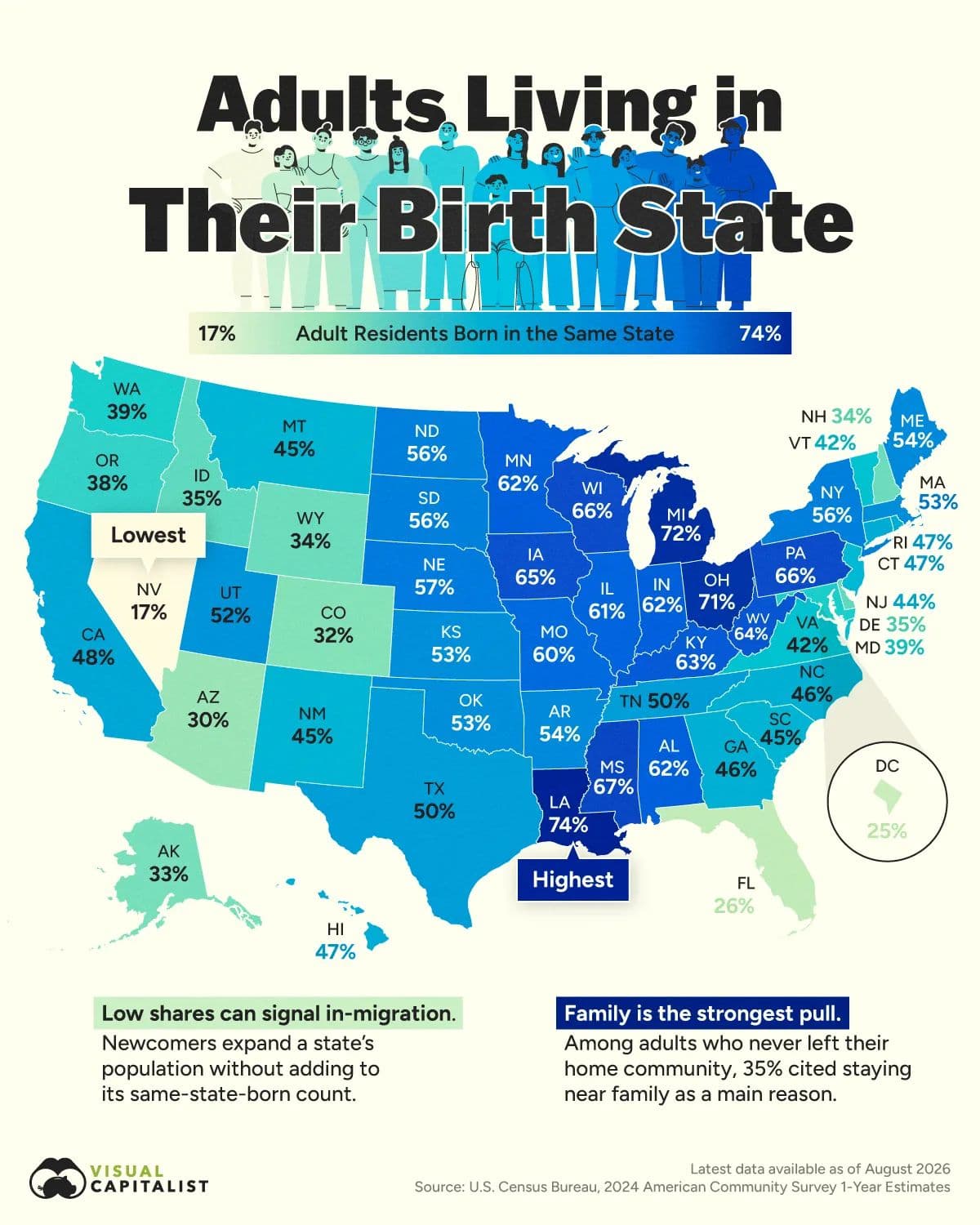
Originally posted by Ryan Kang (Market Stadium). Republished with permission.
Originally posted by Ryan Kang, President of Market Stadium and Advisor to vProp.
Across the U.S., 49% of adults still live in the state where they were born. But the differences between states are striking.
Louisiana leads at 74%, followed by Michigan (72%) and Ohio (71%).
At the other end, just 17% of Nevada’s adult population was born there.
Florida is at 26%, Arizona at 30%, and Colorado at 32%.
From a real estate perspective, these numbers offer another way to think about where housing demand comes from.
States with lower shares of locally born residents have historically relied more heavily on people moving in from elsewhere. That can reshape housing demand, development patterns, and the types of communities being built.
States with higher shares, meanwhile, may have a larger locally rooted population, where family ties and established communities play a bigger role in where people choose to live.
Of course, this isn’t a measure of current migration. It reflects decades of population movement and demographic change.
But combined with migration, employment, housing supply, and affordability data, it adds another useful layer for understanding a market.
Source: U.S. Census Bureau, 2024 American Community Survey 1-Year Estimates (Table B06001); Visual Capitalist (Niccolo Conte)
#RealEstate #CRE #Housing #Demographics #Migration #RealEstateData

Expert
Ryan Kang
Co-Founder & President, Market Stadium
Ryan is a CRE & AI leader with a private equity background, now leading two AI PropTech ventures. He is the Co-Founder & President of Market Stadium, an AI-powered market intelligence platform for commercial real estate that he has led for the past six years, and an Advisor to vProp, an AI video technology company transforming how real estate is marketed. Ryan is also ranked the #7 U.S. Real Estate Voice on LinkedIn by Favikon, sharing insights on real estate, cities, and AI with more than 32,000 professionals on LinkedIn.