How to Break Into Commercial Real Estate Photography
Commercial real estate photography runs on fewer clients and higher fees per assignment. What changes on site, the licensing you need, how to price it, and how to land the first client.
Hailey JeonMarketer, vProp12 min read
TL;DR
Residential listing photography runs on volume, lots of shoots, moderate margin, fast turnaround. Commercial real estate photography runs on the opposite model: fewer clients, longer relationships, and meaningfully higher fees per assignment.
The work itself isn't harder in any abstract sense, but it's different in ways that catch people off guard, and most of what's surprising has nothing to do with the camera itself.
Residential listing photography is a volume business: lots of shoots, moderate margin per job, fast turnaround expectations. Commercial real estate photography runs on the opposite model, fewer clients, longer relationships, and meaningfully higher fees per assignment, which is exactly why it's worth understanding even if you never fully switch over.
The work itself is not harder in any abstract sense. It is different in ways that catch people off guard, and most of the surprises have nothing to do with the camera. They are about who is paying, what the photos get used for, and what a property manager expects from you before you walk in the door.
Why the Margin Is Different
A commercial shoot for an office building, retail center, or industrial property typically commands a meaningfully higher fee than a single residential listing, because the client isn't an individual agent marketing one home, it's a brokerage, developer, or property management company marketing an asset that could be worth tens of millions. The buyer of your service has a bigger budget and a longer sales cycle to justify spending more on marketing.
Part of it comes down to where the money sits. A residential agent usually pays for photography out of a commission they have not earned yet, so every hundred dollars feels like a bet. A commercial brokerage or property management firm treats marketing as an approved line item on an asset that has to lease or sell. The budget exists before you get the call.
Time matters too. A commercial listing can sit on the market for months, and in slower cycles a good deal longer than that. The photos keep working the whole time. That makes a larger photo budget easier to defend internally than it is on a house that might go under contract in two weeks.
What Actually Changes About the Work
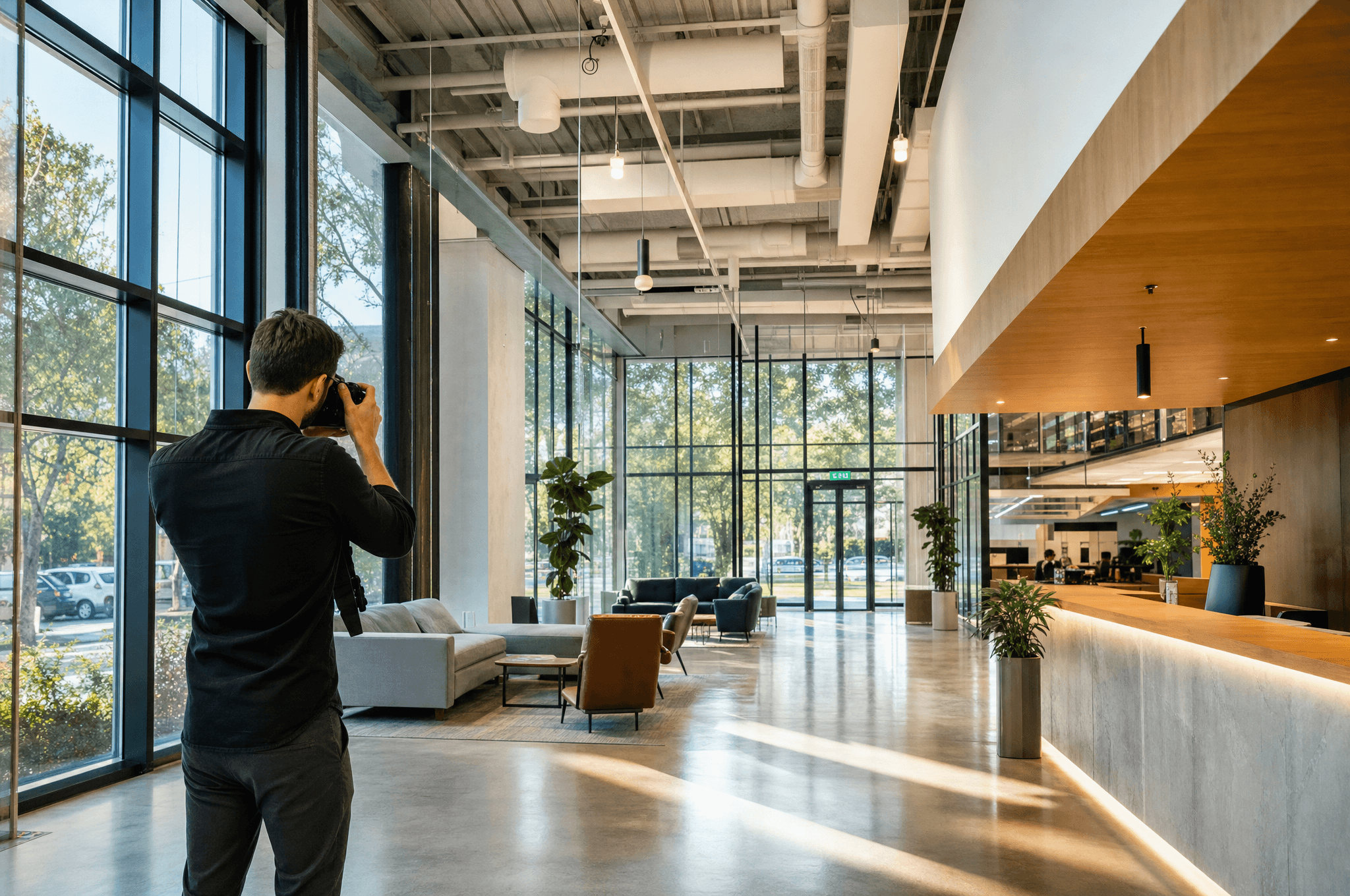
Commercial shoots demand different technical skills than residential. You're working with larger spaces, often requiring wider coverage and more careful lighting to handle high ceilings and mixed light sources, like fluorescent overheads plus daylight through glass curtain walls. Exterior shots often need to communicate scale and location context, like proximity to highways or foot traffic, rather than just curb appeal. And you'll frequently be shooting occupied spaces, meaning coordination with tenants and property managers rather than an empty house.
Hailey Jeon
Marketer, vProp
Hailey Jeon is a marketer at vProp, writing about real estate marketing, listing videos, and the tools agents use to win and market listings. Hailey's guides focus on practical steps agents can use on their very next listing.
Vertical lines get unforgiving. Tall facades and long corridors make lens distortion obvious in a way a living room never does. Tilt-shift work or careful correction in post becomes part of the job rather than a nice extra.
Frame count goes up. A 40,000 square foot warehouse needs coverage that proves the clear height, the column spacing, the dock doors, and the yard. That is closer to a survey than a set of hero shots.
Mixed lighting is the default, not the exception. Warehouse sodium vapor next to skylights, or LED retrofits next to old fluorescent tubes in the same ceiling grid. You either bring enough light to overpower it or you learn to blend exposures cleanly.
Access eats more time than shooting. Badge-in, escort requirements, tenant notice periods, freight elevator reservations. On a multi-tenant building I would budget as much time for coordination as for the camera work.
Empty is not always the target. An occupied retail center with cars in the lot and people walking often photographs better for a leasing pitch than the same center at 6am with nobody in it. Activity reads as demand.
If your technique on the residential side is solid, most of this is an extension rather than a rebuild. The basics still apply, and our real estate photography tips guide covers the fundamentals that carry over.
What Each Property Type Actually Needs
"Commercial" covers a lot of ground, and the shot list changes more than people expect between them.
Office. Lobby and common areas first, then a representative tenant suite, then amenity space if there is any. Buyers and tenants care about finish level, natural light, and floor plate efficiency. A wide shot that shows a full floor plate reads better than three tight vignettes.
Retail. Signage visibility, parking field, and traffic access dominate. A photo that shows the pylon sign against the road matters more than the inside of an empty inline space. Aerials earn their keep here because they show the trade area.
Industrial. Clear height, dock configuration, truck court depth, and column spacing. This is the least glamorous and often the easiest to shoot well, because the buyer wants proof of specifications rather than atmosphere.
Multifamily. Closest to residential work, with one difference: you are selling an income stream, so amenity spaces and unit consistency matter more than any single beautiful kitchen.
Land and development sites. Almost entirely aerial. The job is showing boundaries, road frontage, topography, and what surrounds the parcel.
The Licensing and Insurance Part
Two things trip up photographers moving into commercial work, and neither one is creative.
Drone work needs a certificate. If you are flying for any commercial purpose, including paid real estate photography, the FAA requires a Remote Pilot Certificate under Part 107. You need to be at least 16, able to read, speak, write, and understand English, in condition to fly safely, and you have to pass the Unmanned Aircraft General, Small knowledge exam. The certificate does not expire on its own, but you have to complete free online recurrent training every 24 calendar months to keep your knowledge current (FAA). Aerials come up often enough in retail, industrial, and land assignments that skipping this closes off a chunk of the work.
Property managers will ask for proof of insurance. In my experience this is the step that surprises people most. Institutional owners and larger management firms often require a certificate of insurance showing general liability coverage before they will let you on site, sometimes naming them as an additional insured. It is a routine request on their end and a scramble on yours if you have never had a policy. Getting this sorted before you pitch is cheaper than losing a booking over paperwork.
Site safety rules apply too. On industrial properties or anything with active construction, expect to need a hard hat and a vest, and expect someone to check.
How the Photos Actually Get Used
This one changes how you should think about pricing, so it is worth understanding before you quote anything.
Residential photos live in the MLS, on a few portals, and on social media for the length of one listing. Commercial photos end up in an offering memorandum that gets emailed to hundreds of prospective buyers. They go into CoStar and LoopNet listings, leasing brochures, tenant tour packets, the brokerage's website, and often the owner's own marketing for years afterward.
That wider use is why usage rights show up in commercial conversations and rarely in residential ones. A brokerage might want the images for one marketing campaign. An institutional owner might want them for the life of their ownership, across every broker they hire. Those are different products, and pricing them the same leaves money on the table.
Pricing Without Guessing
I am not going to hand you a rate card, partly because the range across markets is wide enough that any number I gave you would mislead somebody. What I can give you is the structure most commercial photographers end up using.
Price the assignment, not the photo count. Half day and full day rates are common because a commercial shoot's length is driven by building size and access constraints rather than by how many images the client wants. Scope it by square footage and number of buildings, then set the day rate from there.
Then layer the add-ons separately: aerials, twilight exteriors, floor plans, and video. Each one adds real time on site or in post, and bundling them into one flat number makes it hard to sell any of them individually later.
Usage rights are the third layer, and the one most photographers skip. A single-campaign license and a perpetual license for an institutional owner should not cost the same. You do not need complicated paperwork to do this, just a line in your agreement that says what the fee covers.
Travel is worth stating explicitly. Commercial properties cluster in industrial parks and suburban corridors that can be an hour from anywhere.
If you are working out how to package all of this, our guide on structuring photography packages with a video upsell walks through the pricing side in more detail. Video is worth a mention here on its own: commercial clients increasingly expect motion content for leasing campaigns, and turning your existing stills into a narrated walkthrough is a low effort way to add a line item without a second shoot day.
Building the Relationships That Matter
Residential photographers build a client base one agent at a time. Commercial work concentrates around a smaller number of decision-makers: commercial brokerages, developers, and property management firms. Getting in front of them usually means a different kind of outreach than cold-emailing individual agents. Local commercial real estate associations and CCIM chapters, along with brokerage marketing directors, are worth targeting directly, since a single relationship with a mid-size commercial brokerage can produce more recurring revenue than a dozen residential agent relationships combined.
The marketing director is the person to find. At most commercial brokerages, individual brokers do not book photography themselves. Marketing coordinates it, controls the vendor list, and cares about consistency across every listing the office puts out. One conversation with that person can be worth more than twenty broker introductions.
Property managers deserve their own mention because their need is recurring rather than transactional. A broker calls you when a listing comes up. A property manager needs updated photos every time a suite turns over, every time a common area gets renovated, and every year for their own reporting. That is a slower relationship to start and a much steadier one to hold.
Beyond CCIM, look at your local NAIOP and BOMA chapters. Both are full of the owners and managers who actually control these budgets.
Landing the First One
The chicken and egg problem is real: commercial clients want to see commercial work, and you cannot show commercial work until someone hires you. A few ways around it that I have seen work.
Shoot something you already have access to. An office building where you know the manager, a friend's warehouse, the retail center your own studio sits in. Nobody has to pay you for it to go in the portfolio, and one well-shot building of each major type is enough to stop looking like a residential photographer.
Start with property managers rather than brokers. The stakes on any single shoot are lower, the decision is usually made by one person, and if it goes well the work repeats without you having to sell again.
Ask your residential clients. In smaller markets plenty of agents handle both residential and commercial listings, and the ones who do are often frustrated by photographers who cannot handle the commercial side. That is a warm introduction sitting in your existing client list.
Offer a lease-up package on a specific building. A named property with a defined scope is much easier for someone to say yes to than a general offer of services.
Should You Specialize or Add It On?
Most photographers don't need to choose exclusively. Commercial work can start as an add-on service you mention to residential clients who happen to also handle commercial listings, which is common in smaller markets where agents work both sides. As commercial bookings grow, some photographers eventually specialize fully, since the equipment, scheduling patterns, and client relationships diverge enough that running both at high volume gets difficult. There's no wrong entry point, just be honest with yourself about whether you're chasing the higher fees without accounting for the longer sales cycle it takes to land that first commercial client.
That last part is the one I would sit with. The fees really are better. The path to them runs through insurance paperwork, a drone certificate, a portfolio you have to build on your own dime, and a sales cycle measured in months rather than days. If you have the runway for that, it is a good business. If you need revenue this quarter, keep the residential work running while you build it.
Frequently Asked Questions
How is commercial real estate photography different from residential?
It runs on the opposite model: fewer clients, longer relationships, and meaningfully higher fees per assignment, versus the high-volume, fast-turnaround residential business.
Is commercial real estate photography technically harder to shoot?
Not necessarily. The work isn't harder in any abstract sense; it's different in who's paying, what the photos get used for, and what a property manager expects.
Why does commercial photography command higher fees?
The margin structure is different. A commercial shoot for an office, retail center, or industrial property typically commands a meaningfully higher fee per assignment than a residential shoot.
 Hailey JeonMarketer, vProp12 min read