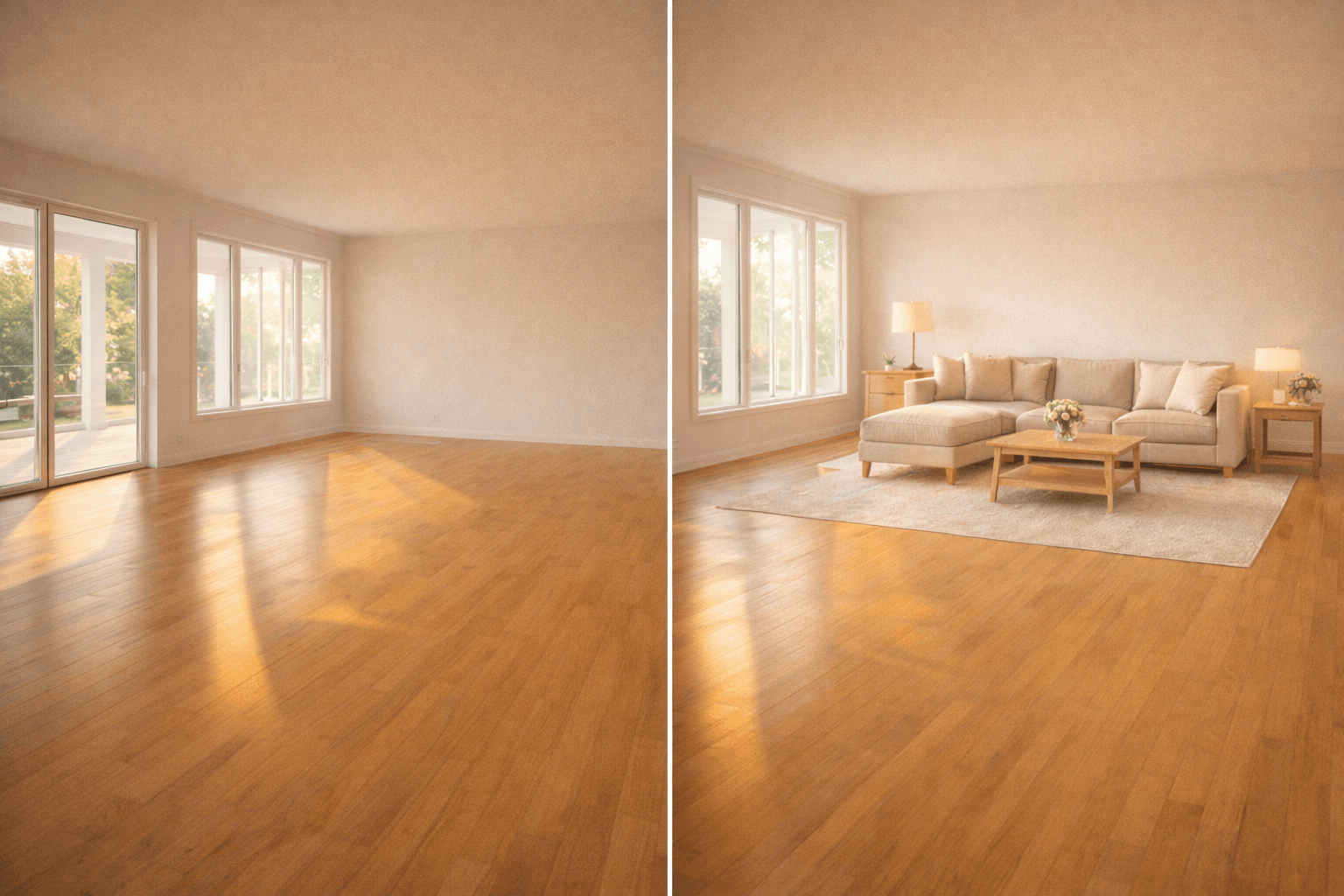
Virtual Staging for Vacant Listings: What Agents Need to Know
Vacant homes attract far fewer showings and tend to sell for less. Virtual staging fixes most of that for a fraction of what physical staging costs. Here is what the research shows and what agents need to know.
Hailey Jeon9 min read
TL;DR
An empty room photographs badly and gives buyers nothing to hold onto, yet agents list vacant homes without staging them every week and then wonder why showings are slow.
Buyers scroll through photos in seconds, and an empty room with beige carpet doesn't stop anyone's thumb. Virtual staging fixes that at a fraction of physical staging's cost, as long as it's done well enough to still look believable.
Walk into a vacant property and pay attention to what you feel. Probably not much. Empty rooms look smaller than they are, photograph badly, and give buyers nothing to hold onto. Agents list vacant homes without staging them every week, and the showing numbers reflect it.
This is a real problem if you're trying to sell a home quickly. Buyers scroll through listing photos in seconds. A photo of an empty white room with beige carpet doesn't stop anyone's thumb. And once they scroll past, they rarely come back.
Virtual staging has become the go-to fix for this. It's faster and cheaper than hauling furniture into a property, and when it's done well, the results are hard to tell from a real photograph. But there's more to it than running a photo through an app. This guide covers the research, the real costs, and what agents should know before using it.
Why Vacant Homes Lose Showings and Sell for Less
The Real Estate Staging Association has tracked this for years. Vacant homes consistently pull fewer showings than staged properties at similar price points. NAR's 2025 Profile of Home Staging puts a number on the buyer side: 83% of buyers' agents said staging made it easier for their clients to picture a property as their future home.
Days on market follow the same pattern. Staged homes sell faster than comparable unstaged ones, and the gap widens the longer a property sits. Every extra week is another week the seller starts asking about a price cut.
There's a psychological piece to this too. Buyers have trouble imagining how their furniture would fit in an empty room. They misjudge scale constantly. A living room that could fit a full sectional and coffee table looks oddly small when there's nothing in it. Staging, whether physical or digital, gives the brain something to work with. It turns a blank space into a place someone can picture living in.
Pricing is affected too. NAR data shows that staged homes were more likely to receive offers at or above asking price. When a buyer can see themselves in a space, they're more willing to pay for it.
Virtual staging takes photos of empty rooms and adds furniture, rugs, art, and lighting digitally. The output is a photorealistic image showing what the space could look like furnished.
The idea has been around for over a decade, but earlier versions were rough. Furniture looked pasted on. Shadows were wrong. Proportions were off. You could tell immediately that the image was manipulated, and that mattered because buyers felt misled. Agents got complaints at showings.
Today's tools are different. AI-based virtual staging platforms can analyze the room's layout, lighting, and dimensions, then place furniture that matches the scale and style of the space. The result is usually convincing enough that buyers can't tell the difference between a virtually staged photo and a traditionally staged one, at least from the listing images.
How AI Virtual Staging Changed the Process
Before AI, virtual staging was basically a graphic design job. A designer would receive your empty room photos, manually select and place each furniture piece, adjust lighting and shadows, and deliver the final images 24 to 72 hours later. Pricing ranged from $100 to $300 per image for decent quality.
AI tools compressed that timeline from days to minutes. Most platforms now let you upload a photo, select a room type and design style, and receive a staged image almost immediately. Some let you choose between modern, mid-century, farmhouse, coastal, and other styles so the result matches the property's architecture and the likely buyer profile.
The speed matters for agents managing multiple listings. Instead of waiting three days for a staging vendor, you can stage an entire property's photo set during the same session you're writing the listing description. For agents who handle high volume, that time savings adds up fast.
Quality varies between platforms, though. Some produce images with floating furniture, impossible shadows, or decor that doesn't match the room's proportions. It's worth testing a few tools with actual listing photos before committing to one.
Virtual Staging Cost Compared to Physical Staging
Physical staging runs $2,000 to $5,000 for initial setup, depending on the property size and the stager's inventory. Monthly rental fees add another $500 to $2,000. A listing that sits for two months can easily reach $6,000 to $9,000 in staging costs alone.
Virtual staging is a fraction of that. Most AI-based platforms charge between $15 and $50 per image, with some offering monthly subscriptions for unlimited images. Staging a full property (six to eight images) might cost $100 to $300 total with no recurring fees.
Physical staging still makes sense in certain situations. Luxury listings where buyers expect to walk through a furnished home, open houses where the in-person experience matters, and properties where the layout is unusual enough that photos alone can't convey the space. For most price ranges and most markets, virtual staging handles the same marketing job at a much lower cost.
There's a flexibility advantage too. If a listing isn't getting traction with one staging style, you can restage the photos digitally in a different style within minutes. Try that with physical furniture and you're looking at another few thousand dollars and a week of coordination.
Does Virtual Staging Actually Work?
Yes, when the quality is there. Poorly staged images with mismatched proportions, wrong shadows, or furniture that clashes with the architecture can hurt a listing more than empty rooms would. Done well, virtual staging produces more clicks, more saves, and more showing requests.
NAR's data backs this up. Staged listings, whether physically or virtually staged, were more likely to receive above-asking offers. Buyers were also more willing to overlook minor property issues when the home was well-presented visually.
Online engagement is where virtual staging shows its biggest impact. Listing photos are the first filter buyers use. A well-furnished living room gets clicked. A photo of an empty room with scuff marks on the wall does not. Multiple studies from real estate portals have shown that listings with staged photos receive significantly more views and saves than those without.
For agents working with sellers who can't afford or don't want physical staging, virtual staging closes that gap. The listing still presents well online, which is where most buyer interest starts.
Which Rooms to Prioritize for Virtual Home Staging
Not every room needs staging. Focus your budget and effort on the spaces that buyers evaluate first.
The living room is almost always the top priority. It's the centerpiece of most listing photo sets and the room where buyers spend the most time imagining their daily life. The primary bedroom comes next. After that, a home office (which has become a major selling point since 2020) and the dining room round out the list.
Kitchens and bathrooms are usually better left as-is in photos, unless they're completely empty. These spaces are judged more on finishes, countertops, and fixtures than on furniture. Adding virtual decor to a kitchen can actually make it look cluttered.
If you're staging a property with an unusual layout, like an open-concept loft or a home with an awkward room that buyers won't know how to use, staging that particular room can answer the "what would I do with this space?" question before it becomes an objection.
Virtual Staging Disclosure Rules Every Agent Should Follow
NAR guidelines require that virtually staged photos be labeled as "Virtually Staged," either in the caption, overlaid on the image, or noted in the listing description. Most MLS systems have the same requirement. Skipping this creates a trust problem when a buyer walks into an empty home expecting furniture.
Disclosure doesn't hurt conversion. Buyers are fine with labeled staged photos. They appreciate seeing what the space can look like, and they understand the photos represent a possibility, not current reality. The risk of not disclosing is much worse: disappointed buyers, complaints to the listing agent, and potential MLS violations.
Some agents overlay a small "Virtually Staged" watermark on the bottom corner of each image. Others include a note in the listing description. Either approach works. Just make sure it's clear.
From Staged Photos to Real Estate Listing Videos
Staged photos drive showings. Video drives more. Video-marketed listings are widely reported across the industry to draw substantially more inquiries than photo-only ones, though the exact multiple varies by source. The natural next step is turning those staged images into a listing video. With AI-based video tools, a narrated walkthrough becomes possible without hiring a videographer. A vacant property that had nothing usable for video suddenly has a full marketing package. We covered the full range of video options in our real estate video marketing guide, including tools that work well with virtually staged images.
Short-form video adds another layer. A 30-second before-and-after reel showing the empty room versus the staged version performs well on Instagram and TikTok. Agents using short-form video for listings have reported strong engagement and follower growth. If you're exploring that format, our guide on real estate Reels and short-form video walks through the full strategy.
Virtual staging won't fix a bad listing. A property that's overpriced, poorly located, or in rough condition still needs those issues addressed. But for a vacant home that shows well in person and just needs better photos, virtual staging is one of the most practical tools an agent can use. The cost is low, the turnaround is fast, and the data consistently shows it works. Pair it with video marketing and a solid pricing strategy, and you've given your listing the best chance of moving quickly.
Frequently Asked Questions
Does virtual staging actually work for vacant listings?
Yes. Empty rooms photograph badly and give buyers nothing to hold onto, so virtual staging is now the go-to fix, and done well, results are hard to tell from a real photograph.
Is virtual staging cheaper than physical staging?
Yes, it's faster and cheaper than hauling furniture into a property, which is why it's become the default option for vacant listings.
Do I need to disclose that a listing photo is virtually staged?
Disclosure practices vary by market and platform, so it's worth checking local MLS and marketplace rules before publishing virtually staged photos.
 Hailey Jeon9 min read