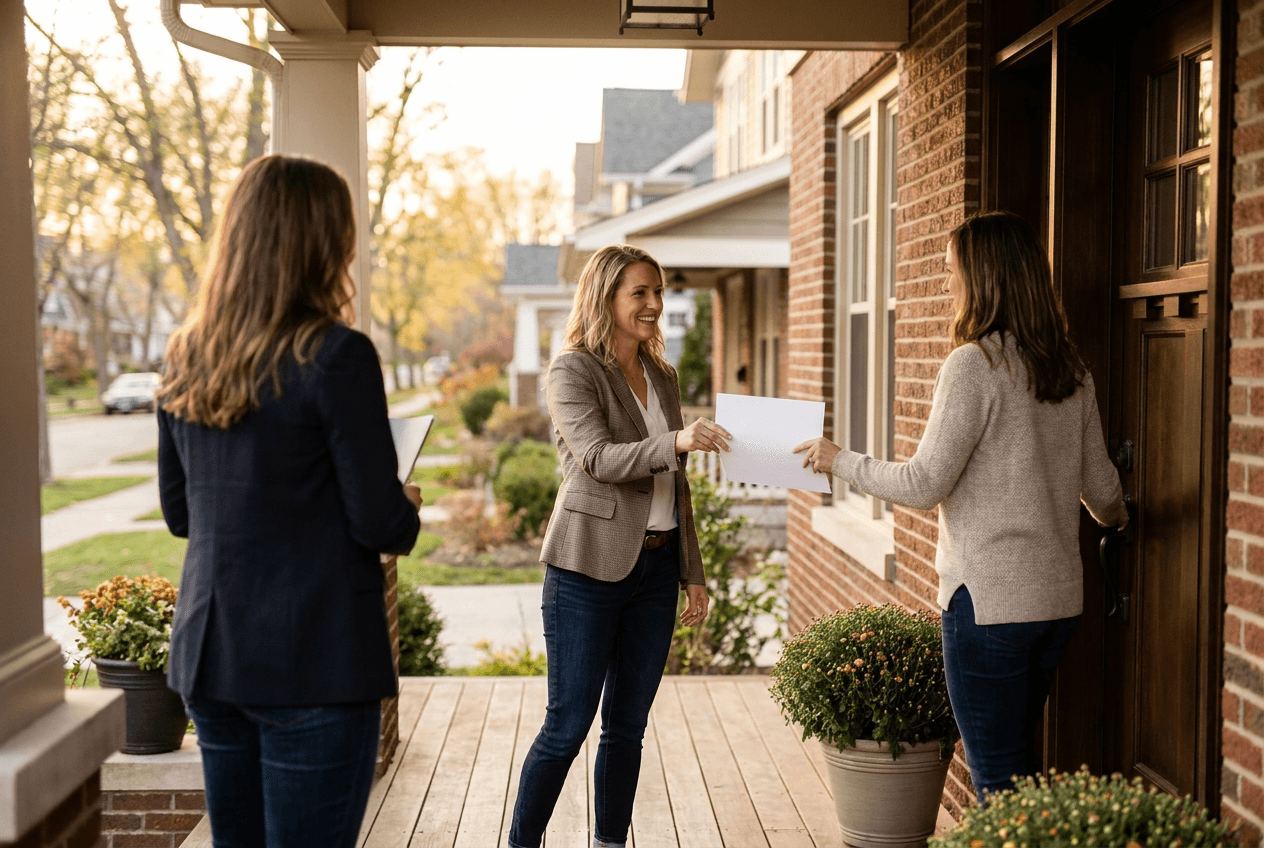
Door Knocking in Real Estate: Scripts, Timing, and How to Make It Pay Off
Door knocking rarely wins a listing on the spot. Here is how agents use it to become the name a neighborhood remembers, with scripts, timing, leave-behinds, and a follow-up plan.
Jennie Ji13 min read
TL;DR
Door knocking still works for real estate agents, but rarely in the way people picture it. Very few sellers hire an agent because a stranger showed up on the porch. In NAR's 2025 Home Buyers and Sellers Generational Trends Report, only 4% of sellers found their agent through personal contact by the agent, while 38% were referred by a friend, neighbor, or relative and 28% went back to an agent they had used before.
So the job of a door knock is to become the agent the neighborhood already knows by the time someone decides to sell. That means knocking around a reason (a new listing, a recent sale, a market update), keeping each conversation under two minutes, leaving something useful behind, and following up in writing within 48 hours. Agents who treat it as a repeatable weekly route, tied to their farm and their CRM, get far more out of it than agents who do one big Saturday blitz.
Does Door Knocking Still Work in Real Estate?
Yes, with a realistic expectation of what it produces. Door knocking is a slow, compounding activity. Any one afternoon is unlikely to turn up a listing appointment, but a year of consistent knocking in the same few hundred homes builds name recognition that very few other activities can match at this price.
The NAR data explains why. In the 2025 Generational Trends Report, 81% of sellers contacted only one agent before choosing who would sell their home, and 66% used a referral or an agent they had worked with in the past. Sellers are not running a big search. They call the person who comes to mind first. Door knocking is one of the few ways to put your face and name in front of homeowners before they have any reason to look you up.
The same report shows that direct mail accounted for 2% of how sellers found their agent and open houses for 3%. None of these channels win on their own. They work as inputs that feed the referral and repeat business that actually produces most listings.
Set expectations before you start. Most doors will not open. Of the ones that do, most people will be polite and brief. A small number will want something from you: a home value estimate, a contractor name, an opinion on what the house down the street sold for. Those are the conversations you are actually knocking for.
When Door Knocking Makes Sense (and When It Doesn't)
Door knocking pays off best when you have a specific, local reason to be on that street. Without one, you are just another person selling something at the door.
Jennie Ji
Hi, I’m Jennie Ji, a designer at vProp. I design experiences that help real estate agents introduce themselves and their listings more easily, save time, and present their properties in a polished way.
You just listed a home. Neighbors are curious about the price and the timing. Many have a friend or relative who wants to move into the area.
You just sold a home. A recent sale gives you a concrete number to talk about, and owners want to know what it means for their own value.
You are hosting an open house. Knocking on 30 to 50 nearby doors a day or two before is a direct way to invite neighbors and fill the house.
You are building a geographic farm. Door knocking is one of the fastest ways to make a new farm area recognize you. Our guide to geographic farming for real estate agents covers how to choose the area itself.
You are following up on mail you already sent. A door knock after two or three postcards turns a name on paper into a person.
Situations where it usually does not pay:
Random neighborhoods you have no connection to and no plan to return to.
Gated communities and buildings with no-solicitation policies.
Areas where your city or HOA restricts or requires a permit for door-to-door contact. Check local rules and your brokerage policy before you start a new route.
Late evenings or early mornings, when people are least receptive.
How to Pick the Streets You Knock
Pick territory by geography and by a reason to be there, then knock every door in that area the same way. Do not choose doors based on who you think lives inside.
This matters for compliance as much as results. Fair housing rules prohibit steering and blockbusting, which includes targeting homeowners based on race, religion, national origin, familial status, disability, or other protected characteristics, or suggesting that a change in who is moving into a neighborhood will affect values. The simplest safe practice is to define a route by streets or a radius around a listing and treat every household on it identically.
Useful ways to define a route:
Radius around a listing or sale. The 50 to 100 homes closest to a property you just listed or sold.
Turnover data. Subdivisions where homes change hands regularly give you more chances to meet someone who is about to move. Your MLS can show you sales history by area.
Length of ownership. NAR's 2025 Profile of Home Buyers and Sellers reports that sellers had owned their home for a median of 11 years before selling, an all-time high. Owners who bought around a decade ago in your area are a natural group to stay in front of, as long as you are knocking the whole street and not cherry-picking houses.
A manageable size. A few hundred homes that you visit repeatedly will beat a few thousand you visit once.
The Best Times to Go Door Knocking
There is no published study that gives one perfect hour, so rely on simple logic and your own tracking. You want people home, awake, and not in the middle of something.
Times that tend to work for many agents:
Weekday late afternoons, after many people get home from work and before dinner.
Saturday late morning to mid-afternoon, especially in good weather when people are outside.
The days right before an open house, when you have a concrete invitation.
Times to avoid: early mornings, dinner hours, Sunday mornings, and any time the weather makes standing at a door unpleasant for everyone.
Track it. Write down the time block, the number of doors, the number of conversations, and any follow-up requests for each session. After four to six weeks you will have your own data on what works in your area, which is more useful than any general rule.
Door Knocking Scripts That Don't Sound Like a Pitch
The goal of the first 15 seconds is to make it clear who you are and why you are there, then hand the homeowner something useful. Keep it short. People at the door are deciding whether to close it, so lead with the reason and not with your credentials.
Just Listed Script
"Hi, I'm [Name] with [Brokerage]. We just listed the home at [address] down the street, and I'm letting neighbors know before it shows up everywhere online. We're having an open house on Saturday from 1 to 3 if you want to see it. Do you know anyone who's been hoping to move into the neighborhood?"
Then stop talking. If they ask about price, tell them. If they want to chat, let them lead.
Just Sold Script
"Hi, I'm [Name] with [Brokerage]. We just closed on [address] around the corner, and a lot of neighbors have been curious about what it sold for and how quickly. I put together a one-page summary of recent sales on the street. Would that be helpful to have?"
The one-page summary is the point. It gives the homeowner a reason to keep the paper and a reason to call you later. Our guide to just sold postcards has wording you can reuse for the leave-behind.
Market Update Script
"Hi, I'm [Name], I work this neighborhood with [Brokerage]. I'm stopping by with a short market update for the street, what has sold this year and what's on the market right now. No pitch, just figured it's useful to have. Do you have a minute, or should I just leave it with you?"
Offering to "just leave it" takes the pressure off, and people are often more willing to talk once they know they can say no.
Open House Invitation Script
"Hi, I'm [Name]. I'm hosting an open house at [address] this Saturday and wanted to invite the neighbors first. It's a good chance to see how the home is finished and what it's priced at. Here's a card with the details."
Most responses fall into a few patterns. Have an answer ready for each, and keep every answer shorter than the question.
"We're not interested in selling."
"Totally understand. Most people I talk to aren't. I just like neighbors to know who works the area. Can I leave this market summary with you?"
"We already have an agent."
"Great, that's good to hear. If they ever want comps on the street, I'm happy to share what I have. Have a good afternoon."
"How much is my house worth?"
This is the best response you can get. Do not guess at the door. Ask two or three questions about updates, then offer to send a proper estimate. A real comparative market analysis delivered within a day or two is a strong reason for a second conversation.
"We're thinking about it, maybe next year."
Ask what would need to happen for them to move, and when it would make sense to check in. Write down their answer word for word. That note is what makes your follow-up feel personal months later.
No answer.
Leave your door hanger or summary and note the address as "no contact." Some agents go back to no-contact homes on a different day and time, since a household that is never home on Saturdays may be home on Wednesday evenings.
What to Leave Behind
Your leave-behind is what the homeowner sees after you walk away, so it should be worth keeping. A generic business card is the weakest option.
Leave-behinds that tend to get kept:
A one-page street or subdivision sales summary. Recent sales, days on market, and active listings, with your contact details.
A local vendor list. Plumbers, electricians, painters, and handymen you trust. Homeowners tend to hang on to these.
An open house invitation with the date, time, and a photo of the home.
A link or QR code to a short listing video. A 30-second video of the home you just listed or sold is easier to share with a friend than a flyer. If you don't have one, tools like vProp can turn your listing photos into a narrated video in a few minutes.
Keep the design clean and the information specific to that street. People can tell a mass-printed flyer from something made for their neighborhood. For more on what makes printed pieces work, see our guide to real estate flyers.
How to Follow Up After Door Knocking
The follow-up is where door knocking either turns into business or disappears. Most agents skip it, which is why the agents who don't skip it stand out.
A simple follow-up system:
Log every conversation the same day. Address, name if given, what they said, and any request. A notes app works, but a CRM is better because it reminds you.
Deliver anything you promised within 48 hours. If someone asked for a home value, a vendor, or sales data, send it quickly. Speed is the easiest way to show you are reliable.
Send a short handwritten note to anyone you had a real conversation with. Two sentences that mention something specific from the talk is enough.
Put them on a light touch schedule. A market update every month or two by mail or email, and a knock on the same door every few months.
Invite them to your next local event or open house. Repeated, low-pressure contact is how you become the agent they think of first.
If you already send a newsletter, door knocking is one of the best ways to grow the list with people who actually live in your farm. Ask for an email address only after you have given them something useful.
How to Measure Door Knocking Results
Track a few numbers every week so you can judge door knocking against your other lead sources instead of guessing.
The early numbers will look slow. That is normal for an activity whose payoff comes from repeated exposure. Give a route at least three to six months before deciding whether it works, and compare it to what you spend on mail, ads, or paid leads over the same period.
One useful habit: when a new client contacts you, ask how they heard about you and whether they remember you from the door. Some will say a neighbor mentioned you, which is the referral effect door knocking is supposed to create.
Key Takeaways
Door knocking rarely produces a listing on the spot. It works by making you the one agent a neighborhood remembers when someone decides to sell.
NAR's 2025 data shows 81% of sellers contacted only one agent, and 66% used a referral or a past agent. Being known locally matters more than being found.
Always knock with a reason: a new listing, a recent sale, an open house, or a market update.
Define routes by geography and treat every household the same. Never choose doors by who you think lives there.
Keep scripts under 30 seconds, leave something worth keeping, and follow up within 48 hours.
Track doors, conversations, and requests so you can judge results after a few months of consistent effort.
Frequently Asked Questions
Is door knocking effective for real estate agents?
It can be, as a long-term activity in a defined area. NAR's 2025 Generational Trends Report found that only 4% of sellers found their agent through personal contact by the agent, but 38% came through a friend, neighbor, or relative. Door knocking works best when it builds that local recognition and those neighbor referrals over months.
What should I say when door knocking for real estate?
Lead with who you are and the specific reason you are on the street, such as a new listing nearby, a recent sale, or an open house. Offer something useful, like a sales summary for the street, and keep the opener under 30 seconds. If the homeowner asks about their home value, offer to send a proper estimate rather than guessing at the door.
How many doors should I knock to get a listing?
There is no reliable published ratio, and results vary a lot by market and by how consistently you return to the same streets. A better approach is to track doors knocked, conversations, and follow-up requests for three to six months in one area, then compare that against your other lead sources.
 Jennie Ji13 min read